The Future of AI: What to Expect Next
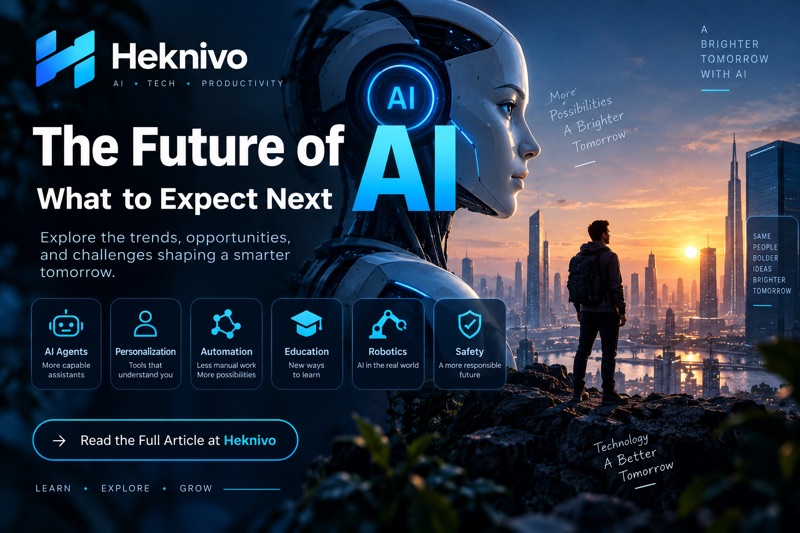
Artificial intelligence has moved from being a futuristic concept to becoming part of everyday life. People already use AI to write, research, create images, analyze information, learn new skills, and automate repetitive tasks.
But this is only the beginning.
As AI technology continues to develop, the way we work with computers, software, and digital services is likely to change significantly. Some developments are already appearing, while others are still emerging.
Here are some of the major trends to watch in the future of AI.
1. AI Agents Will Handle More Tasks
Today’s AI tools often respond to individual requests. The next generation of AI is increasingly focused on agents that can complete multiple steps toward a goal.
For example, instead of asking an AI to write an email, an AI agent could potentially help organize information, prepare a draft, work with connected tools, and complete parts of a workflow based on your instructions.
This could make AI much more useful for everyday productivity.
2. AI Will Become More Personalized
AI systems are becoming better at understanding context and adapting to individual users.
Future AI assistants may provide more personalized help based on a user’s preferences, projects, learning goals, and workflows.
Instead of using exactly the same experience as everyone else, people may have AI tools that work more like personal digital assistants.
3. AI Will Become More Multimodal
AI is no longer limited to text.
Modern systems can increasingly work with combinations of:
- Text
- Images
- Audio
- Video
- Documents
- Software interfaces
This trend is known as multimodal AI.
In the future, communicating with AI may feel more natural because you can combine different types of information in a single interaction.
4. AI Automation Will Grow
Many repetitive digital tasks could become increasingly automated.
Businesses and individuals may use AI to help with tasks such as:
- Organizing information
- Summarizing documents
- Processing routine requests
- Generating reports
- Managing workflows
- Analyzing data
The goal isn’t necessarily to eliminate every human task. Instead, automation can allow people to spend more time on tasks that require judgment, creativity, communication, and decision-making.
5. AI Will Change How We Search for Information
Traditional search usually requires you to enter a query, open several results, and find the information yourself.
AI-powered search can provide more conversational answers and combine information from multiple sources.
This could change how people discover information online.
However, users should still verify important information because AI-generated answers can contain mistakes or incomplete information.
6. AI Will Become More Common in Education
AI can already help students understand difficult concepts, practice languages, generate questions, and organize study materials.
Future educational tools may become more personalized by adapting explanations and exercises to each learner.
The challenge will be finding the right balance between AI assistance and independent thinking.
AI should help people learn—not simply do the learning for them.
7. AI and Robotics Will Become More Connected
AI is primarily associated with software, but its capabilities can also be combined with physical machines.
As robotics improves, AI may help robots understand environments, interpret instructions, and perform increasingly complex tasks.
This could have applications across manufacturing, logistics, healthcare, research, and other industries.
8. AI Will Create New Types of Jobs
Technology often changes the skills people need.
As AI takes over some repetitive tasks, new roles may develop around areas such as:
- AI implementation
- AI safety
- Data management
- Automation
- AI-assisted content creation
- Human-AI collaboration
At the same time, many existing jobs may change rather than simply disappear.
Learning how to work effectively with AI could become an increasingly valuable professional skill.
9. AI Safety and Privacy Will Become More Important
As AI becomes more powerful and more deeply integrated into digital services, questions about privacy, security, reliability, and responsible use will become increasingly important.
People and organizations will need to think carefully about:
- What data AI systems can access
- How personal information is stored
- How AI decisions are reviewed
- How inaccurate outputs are detected
- Who is responsible when something goes wrong
Responsible AI development will be an important part of the technology’s future.
10. AI Will Become Easier to Use
One of the biggest changes may be simplicity.
You don’t necessarily need to understand how machine learning models work to benefit from AI.
Future tools may hide much of the technical complexity behind simple interfaces, allowing more people to use advanced AI capabilities without specialized knowledge.
This could make AI technology accessible to a much larger audience.
How Should You Prepare for the Future of AI?
You don’t need to become an AI engineer to prepare.
Start by learning the basics and experimenting with useful AI tools.
You can begin with our guide:
👉 Best AI Tools for Beginners in 2026
You can also improve the way you communicate with AI by learning practical prompting techniques:
👉 25 ChatGPT Prompts for Beginners to Save Time
And if you want to use AI more effectively in your daily routine:
👉 10 Ways AI Can Save You Time Every Day
The Human Side of AI
The future of AI isn’t only about smarter machines.
Human skills such as creativity, critical thinking, communication, problem-solving, and judgment will continue to matter.
The most useful approach may be learning how to combine those human abilities with increasingly capable AI tools.
Final Thoughts
AI is developing quickly, but nobody can predict exactly what the technology will look like several years from now.
What we can see is a clear direction toward more capable, personalized, multimodal, and automated AI systems.
The best way to understand this changing technology is to learn, experiment, and stay informed.
The future of AI is being built now—and learning how to use it is a skill worth developing.
🚀 Explore Heknivo
For more practical guides about AI, technology, productivity, and digital tools:
Learn smarter. Work better. Explore what’s next.


Comments
Post a Comment